The short answer: The best Orlando suburb for you comes down to three things: how far you want to drive, the life you want, and your budget. Picture downtown Orlando as the center of a compass. In my experience, the southeast (St. Cloud, Narcoossee, Harmony) and the northwest (Clermont, Groveland) give you the most house and land for the money, usually 30 to 40 minutes from downtown. The north and west (College Park, Winter Park, Windermere) cost more and put you closer in or on the big lakes.
By Cliff Clover, REALTOR. I've lived in St. Cloud since 2000, sold homes in Central Florida since 2001, and flown over most of it. Updated November 24, 2026.
Orlando suburbs run in every direction from downtown, and each direction feels different. Some are metro. Some are suburban. Some are rural, with room for cattle. The best suburbs of Orlando for one buyer can be the wrong fit for the next one.
So I don't start with a list. I start with a few questions, and then we go around the compass.
Not sure which direction fits you? Book a 15-minute call with me or call or text (321) 320-7129.
Start With Three Questions
When someone tells me, "We want to live near Orlando, but we don't know where," here's what I ask first:
- How much driving do you want to do? If Orlando is the center of the compass, how do you want to get to the center?
- What matters most to you? Amenities, community, location. Your hobbies, where your job is, the kind of schools you want.
- What's your budget? That word means different things to different people. Some buyers have a strict number. Some don't have one yet.
Sometimes it's about a zip code. Sometimes it's about a passion: boating, fishing, riding bikes, the outdoors. Or raising animals, like fresh eggs, goats, cattle and dogs. All of these shape where I point a buyer. But it really comes back to budget.
The Orlando Suburbs Compass
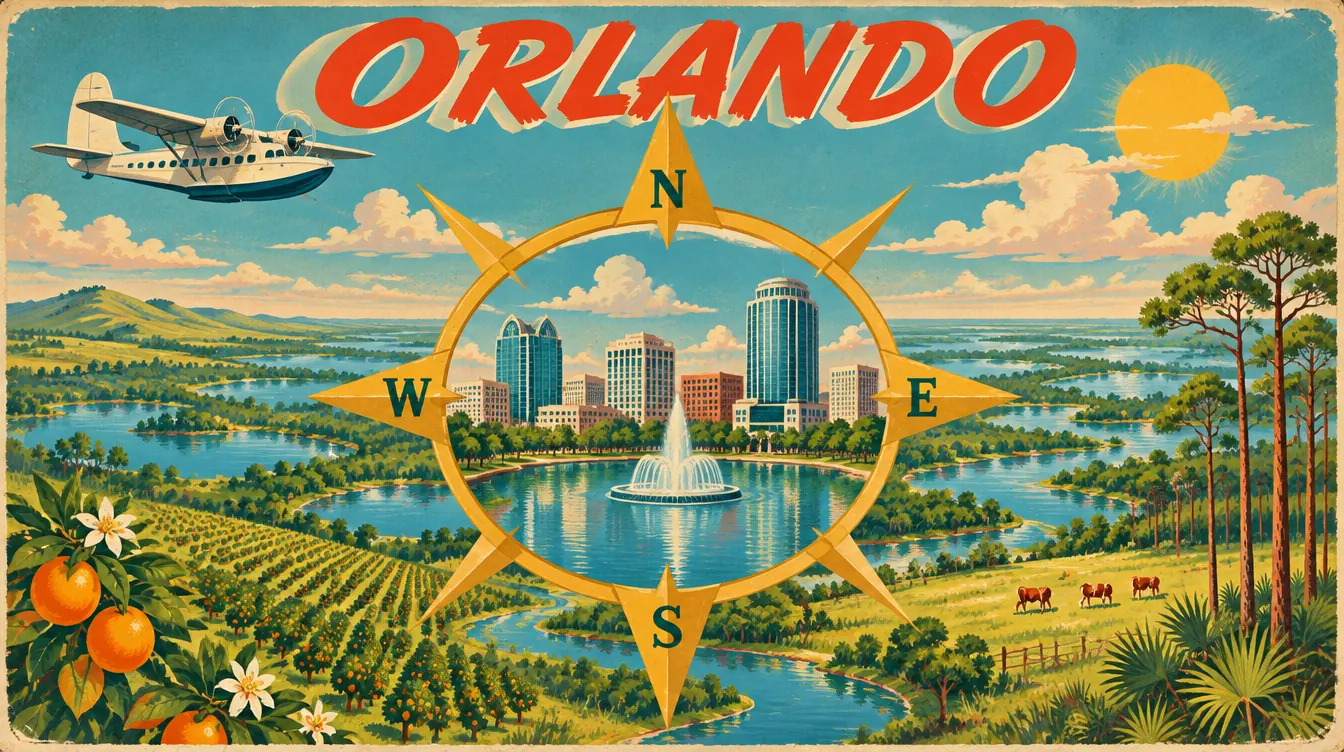
Here's what sits where. Each direction gets its own section below.
North: Older Charm, Close to Town
Just north of downtown is College Park. It's older and well established, with homes that have the charm of the early 1900s. Most have been well modernized, and many are beautiful.
Winter Park is an extension of College Park, and it's home to Rollins College. Prices run higher here. There's typically no HOA, and you get a downtown feel close to the city. You'll also see more detailed, less modern architecture in both areas.
Farther north are Altamonte Springs and Casselberry. To the northeast, Oviedo and the Alafaya Trail area sit out by UCF, the University of Central Florida.
East: Built to Live and Work
Azalea Park sits due east of downtown. Farther out are two of Orlando's planned communities, built so you can live, shop and work in one place.
Baldwin Park is inside the Orlando city limits. It's higher end and fully built out. Avalon Park, farther east, works the same way: a full community built for people to live and work there.
Southeast: The Most House and Land for the Money
This is my backyard, and in my experience it's the best direction for getting the most house and land for your money. It's also closer to Orlando International Airport.
Belle Isle and Conway
Just north of the airport, Belle Isle and Conway are classic, older Orlando. Many streets have no HOA, and there's a lot of luxury here. You'll find lakefront and lake-access homes too.
Lake Nona and Medical City
Lake Nona is growing fast. It has luxury homes and newer communities with HOA and CDD fees. My Lake Nona buyer guide goes deeper.
Narcoossee
Past Lake Nona, Narcoossee Road runs into north St. Cloud. Communities are going up along that road at a very fast pace. Many come with soccer fields and pickleball and tennis courts. People who work at Medical City or the airport often look here. See my guide to Narcoossee and North St. Cloud.
Harmony
Farther southeast is Harmony, a golf course community with schools inside it and a lot of new subdivisions. Its Buck Lake is a quiet lake, with community boats for residents. Check Harmony's current lake rules before you count on bringing your own. Around Harmony, you start to find 1-acre and 5-acre lots and bigger land tracts. My Harmony buyer guide has more.
St. Cloud
Keep heading south and you reach old St. Cloud, the downtown, on East Lake Toho. There are subdivisions here and bigger land tracts too, from 5 to 20 acres. Lakefront options include Alligator Lake, Lake Lizzie, Live Oak Lake and others.
Along Canoe Creek Road there's a golf course community, and there's Gator Airpark, a private grass runway where homeowners can fly from home. A lot of the builders' growth now follows Old Canoe Creek Road.
Then there's Kissimmee Park Road, the area we call Cross Prairie, right along the Florida Turnpike on the south side. I'm watching thousands of homes go in there: luxury townhomes, multifamily and single family. You can still find 1-acre, 5-acre and 20-acre tracts out there too, and some have direct access to Lake Toho.
To the west, off Neptune Road, there's a lot of new building near NeoCity, Osceola County's tech district.
Start with my St. Cloud buyer guide and my picks for the best neighborhoods in St. Cloud. If you're weighing it against the city, see how much more house St. Cloud buys vs. Orlando.
Want the most house or land for your budget?
Tell me how far you'll drive and what you want room for. I'll point you to two or three areas worth seeing.
South: Kissimmee and Lake Toho
Moving west into Kissimmee, you'll find older homes right on Lake Toho (Lake Tohopekaliga) with direct lake access.
Lake Toho is one of the few lakes in Central Florida with a way out. It connects through a chain of lakes and locks south to Lake Okeechobee, and from there you can go on to the Gulf or the Atlantic. That's not true for every lake with "Toho" in the name. No boat lock connects East Lake Toho or the Alligator Chain to Lake Toho. So if you're a boater and passionate about fishing, Lake Toho is the destination, not East Lake Toho.
Down Pleasant Hill Road is Bellalago. Its homes sit on canals, and a boat lift takes your boat over into Lake Toho. If you want boat access without spending millions, it's a tremendous option, with beautiful homes and shopping close by.
The catch is Pleasant Hill Road. It's a busy north-south route, and it gets very congested. That road also leads to Poinciana and South Kissimmee, where you'll find 55-plus communities and lower-priced homes. Many people choose Poinciana to get more house. Just know the commute to Orlando can be very slow at busy times.
For more, see my Kissimmee buyer guide or Kissimmee vs. St. Cloud.
Southwest: Celebration and the Vacation-Home Corridor
West of Poinciana, along Highway 27, are Davenport and Four Corners. These areas grew fast with short-term rental investors, and many communities here are approved for vacation rentals. There's newer building for full-time living too. Check the zoning and HOA rules for each address.
Reunion is a world-class golf destination, with high-end second homes. Communities like Indian Ridge and Windsor Hills are part of the Four Corners area too. If you're buying to rent, start with my guide to vacation homes near Disney.
Celebration is different. Short-term rentals aren't allowed. It's a high-end planned community, inspired by Walt Disney's vision for a planned town and built by his company in the 1990s. People know it for its architecture and well-planned streets. At Christmas, people come from all over to see it. There are horse-drawn carriage rides, and snow machines make it "snow" in Town Center. My Celebration buyer guide explains its HOA rules.
West: Big Lakes, Luxury and Florida's Hills
North of Celebration is Walt Disney World. Past it are Dr. Phillips, Bay Hill, Windermere and Isleworth. This is high-end luxury, much of it on the Butler Chain of Lakes. Most lake-access homes here are in the multi-million-dollar range. If you work in the city, Windermere gets you there in maybe 25 minutes at best. See my guide to Windermere and the Butler Chain.
Keep going west on Highway 27 and you reach Clermont. It has a lot of new subdivisions, and it's one of the few places in Florida with real hills. If you come from rolling hills, you'll feel at home. Olympic athletes train at the National Training Center, and cyclists come for the climbs. Clermont has lakes for water sports too. It runs into Minneola. My Clermont buyer guide has more.
For something more rural, head to Groveland. You'll find acreage there, with 1, 5 and 20 acres available.
Northwest: A Downtown Vibe and Older Neighborhoods
Heading northwest, you pass Montverde and Lake Apopka and come to Winter Garden, which connects Clermont and Windermere. There's a lot of new building along the 429. Then there's old downtown Winter Garden, which people love for its farmers market, restaurants and vibe. In my experience, it costs less than Windermere and a bit more than Clermont. See my Winter Garden buyer guide.
Ocoee is mostly older Orlando subdivisions, where HOAs are light or missing and CDDs are rare. From there, Pine Hills, South Apopka, Forest City, Altamonte Springs and Casselberry bring you back around to the north. That's the compass.
New Community or Older Neighborhood?
Wherever you land, you'll face this choice.
New communities give you less land and a tighter neighborhood, and that lifestyle costs more in HOA and CDD fees. But you get real sidewalks and a chance to know your neighbors. Many have a gym or welcome center, a community pool, dog parks, soccer fields and pickleball, tennis and volleyball courts. If that's what you're into, there's no shortage of them. The southeast and northwest are the two big areas for new construction, and they're close to the new shopping and schools.
Older areas and acreage usually give you more house and land for the money. You may find no HOA, or only light rules, so chickens or a boat in the yard may be fine. How much land is enough is up to you: a quarter acre, a half acre, an acre or more. In my experience, most areas that give you more land are about 30 to 40 minutes from downtown Orlando. That's not bad compared with other places.
One more thing to know: growing pains. Many communities were approved and are being built faster than the roads have caught up. Before you buy, drive the route you'll take every day. My guides to HOA vs. CDD fees and new homes in St. Cloud explain what to check.
Three Mistakes I See Buyers Make
1. Not reading the HOA rules
The biggest mistake I see when people move here: they pick a community that feels perfect, then find out what the HOA doesn't allow. They want a boat in the driveway or the backyard, a shed, or room to park another car or their toys. The HOA's parking and storage rules say no. They get upset, because no one made it clear or they didn't understand it. Get the rules before you make an offer, and read the parking and storage parts first.
2. Falling for the tree
Central Florida has beautiful oak trees with Spanish moss, plus magnolias and cypress. People buy a home because of the big tree out back. Then the neighbor cuts the limbs that hang over their fence or roof, and the buyer takes it personally.
Here's what to understand. If your tree hangs over your neighbor's property, it's a safety issue in storm season. And under Florida law, your neighbor can trim healthy branches back to the property line, at their own cost. This isn't legal advice. For your own case, ask a certified arborist or a real estate attorney.
3. Only seeing the house in the daytime
Buyers often rush into a home they saw once, in the daytime, with their Realtor. Night is when it changes. Everyone's home and driving, and a street that had hardly any cars at noon can look like a parking lot at 7 p.m. Go back at night, and on a weekend, before you decide.
What I See From the Cockpit

I've been a licensed commercial pilot since 2003, and I see these areas from the air. From up there, I can see where the development is going. I see where traffic stops up and which roads stay jammed. I see where new roads are being built, and what's coming that will change a buyer's decision.
I also see the lakes the way most people can't. Which ones are spring-fed. Which ones are managed or connected by canal. Which ones are part of a chain you can boat to other lakes from, and which ones leave you stuck on one body of water. From the air, the difference between Lake Toho and East Lake Toho is plain to see. From a listing photo, it isn't. More on that on my pilot's view of Central Florida page.
Why I Chose St. Cloud

Before St. Cloud, we lived in a golf course community in Kissimmee. It was a great place to raise my kids, and it was close to the Kissimmee airport, where my office was and where I flew out of often.
As our family grew, we looked at other options. I'm an avid boater, so I wanted lake access. But I also wanted land and large animals. We chose land, so I could have cows and chickens and give my kids the kind of life I enjoyed growing up. Today that means my bull Vader, my donkey Ranger and room for my dog Captain to run.
I still have the lake. The closest boat ramp is a mile and a half away, and it puts me on Lake Toho, the chain of lakes and the locks with my family. I'm farther from the airport now, but I can land a helicopter on my own property. (So can my neighbor. He's a helicopter pilot too.) I'm 12 minutes from the Turnpike and about 30 minutes from downtown Orlando. I wouldn't trade it.
I chose land over lakefront to get room for Vader, and a mile and a half to the ramp turned out to be a fair trade. Finding your trade is part of how I work with buyers. If you're still early in the move, start with my guide to moving to Central Florida, then check the cost of living in Orlando for homeowners.
I can show you where the roads are going and which lakes connect. What I can't tell you from here is which direction will feel like home. You'll know that one when you drive it. Maybe at night.
Ready to pick a direction?
Book a 15-minute call. Tell me your drive, your must-haves and your budget, and I'll narrow the compass to two or three areas.
Frequently Asked Questions
What are the best suburbs of Orlando?
It depends on your drive, the life you want and your budget. In my experience, the southeast (St. Cloud, Narcoossee, Harmony) and the northwest (Clermont, Groveland) give the most house and land for the money. College Park, Winter Park and Windermere cost more and sit closer in or on the big lakes.
Which Orlando suburbs give you the most land for the money?
In my experience, the southeast around St. Cloud, Harmony and Canoe Creek Road, plus pockets near Clermont and Groveland in the northwest. You can find 1-acre, 5-acre and 20-acre tracts. Most are about 30 to 40 minutes from downtown Orlando.
Which Orlando suburbs have no HOA?
Older areas often have no HOA or only light rules. That includes many streets in College Park, Winter Park, Belle Isle, Conway and Ocoee, plus rural land outside St. Cloud and Groveland. Rules can change street by street, so check each address.
Can I boat from Lake Toho to Lake Okeechobee?
Yes. A chain of lakes and boat locks connects Lake Toho to Lake Okeechobee, and from there you can reach the Gulf or the Atlantic. East Lake Toho and the Alligator Chain are different: no boat lock connects them to Lake Toho.
Which Orlando suburbs allow short-term rentals?
Many communities around Davenport, Four Corners and Highway 27 are approved for vacation rentals. Celebration does not allow short-term rentals. Always check the zoning and HOA rules for the exact address.
How long is the drive from the suburbs to downtown Orlando?
From most areas with more land, about 30 to 40 minutes in my experience. From my home in St. Cloud, I'm 12 minutes from the Turnpike and about 30 minutes from downtown. Rush hour can change that a lot, so drive it at the time you'd commute.
Can my neighbor cut branches off my tree?
Under Florida law, a neighbor can trim healthy branches that hang over their property back to the property line, at their own cost. This isn't legal advice. Ask a certified arborist or a real estate attorney about your own case.
Cliff Clover, REALTOR® | The Clover Group at eXp Realty, LLC | (321) 320-7129 | Serving Central Florida since 2001. This page is general information and my own experience, not legal or financial advice. Drive times are from my experience and change with traffic. Community rules, zoning and school assignments change; check the sources below for each address.