The short answer: There are more homes for sale than buyers who can qualify, and too many sellers are pricing off numbers from before rates went up. Homes priced on old numbers sit. Homes priced on what is selling today still sell, sometimes with more than one offer.
I have sold homes in Central Florida full time since 2001, and I live in St. Cloud. Here is what I see every day that the headlines leave out.
The Real Reason Homes Are Sitting
More homes than qualified buyers
It starts with supply and demand. Right now there are more homes for sale than there are buyers. Demand comes from affordability, and affordability comes down to one thing: can a buyer qualify for a mortgage and make it to closing? For a lot of people right now, renting costs less each month than owning, so they stay put.
Sellers are pricing off last year
When rates go up, home prices usually have to come down to keep the payment affordable. A two-point jump in rates can add hundreds of dollars a month to a buyer's payment, before taxes, HOA, or CDD fees.
But many sellers look at sales from six months to a year ago, before rates went up, and say, "My neighbor sold for this, so I should too." That is not how this market works. The buyer for your home has a different payment than the buyer for your neighbor's home did.
Some agents just want the sign in the yard
Some sellers hire the agent who tells them the highest number. That agent gets the listing, and the seller gets months on the market. Other sellers do not have much equity, so they try to get every dollar to avoid being upside down. That is part of why I am seeing more pre-foreclosures, short sales, and foreclosures come on the market.
Owners who bought during COVID feel stuck
Many owners who bought during COVID locked in a very low rate, and they do not want to trade it for a higher one. I understand that. What most of them do not realize is that the equity they have built can often be used to buy down the rate on their next home to a payment that works.
That is the mistake I see most: people focus on the rate instead of the payment. We don't look at the price. We look at the payment. That is how you judge whether something is affordable.
A Real Example: When Square Footage Lies
I had a listing in Lake Nona that was priced right. The sellers had put a lot of work into the home, and it was unique: a single-story home with upgrades and options.
The neighborhood also had two-story homes that showed more square footage and sold for less. A buyer's agent used that against us. Their argument was simple: bigger homes are selling for less, so yours is overpriced. Based on that, their buyer made an offer well under fair market value.
Here is the problem. A two-story home can show more square feet, but stairs, landings, and tall open spaces take up part of it. A single-story home with fewer square feet can live bigger and come with more options. Price per square foot alone is comparing apples to oranges, and buyers moving here from out of state usually do not know that.
We did come to an agreement, and the home sold. But it shows why you need someone who knows the difference between a number on paper and what a home is really worth to the person walking through it.
How I Would Sell a Home in 60 to 90 Days Right Now
Start with a pre-listing inspection
This shows you everything that is wrong with the home before a buyer finds it. Then you have two choices:
- Fix it, or
- Price for it and disclose everything up front
Either way, the buyer's agent can't come back after their inspection and renegotiate. In my experience, sellers who skip this step can lose $10,000 to $40,000 or more in that renegotiation.
Price off the right numbers
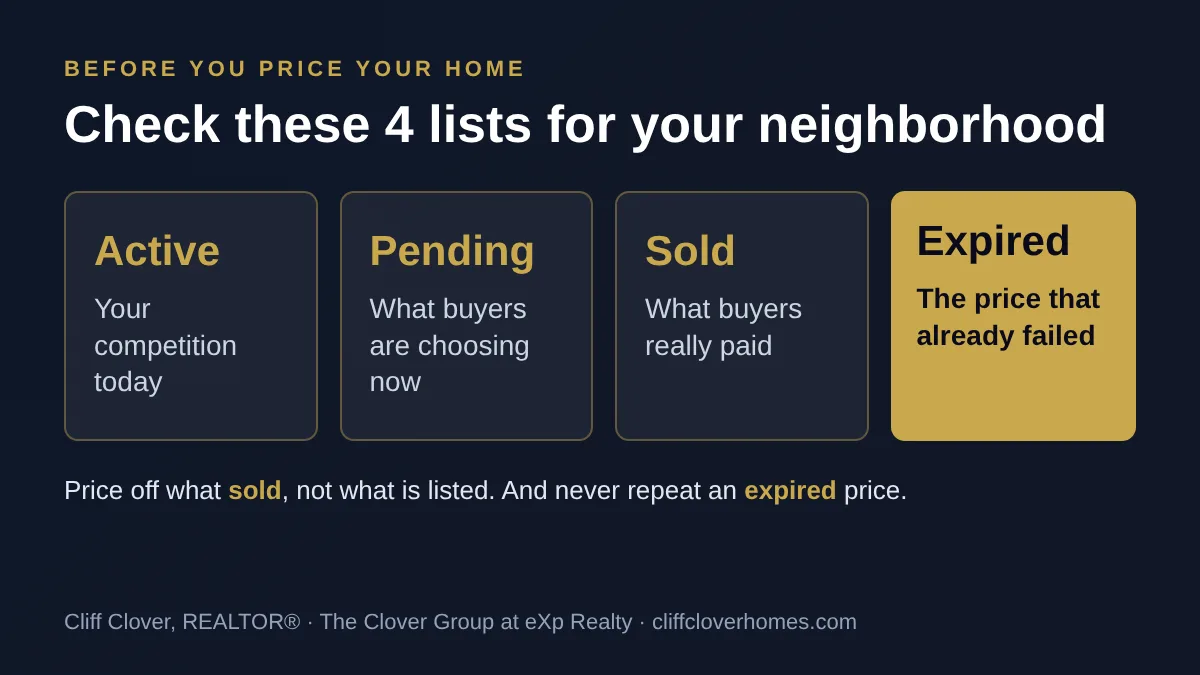
I look at four lists for the neighborhood:
- Active: your competition today
- Pending: what buyers are choosing right now
- Sold: ideally within the last 90 days and within 3 to 5 miles, if the sales allow
- Expired: homes that did not sell
The expireds are the smoking gun. If a similar home expired at a certain price, someone already tried that number and it did not work.
Plan for the buyer's closing costs
Most buyers in this market do not have the cash for closing costs and prepaids. If the home is priced right and there is enough equity, we can list at true value and, when a buyer needs help, build those costs into the price. Builders do the same thing every day. The buyer gets their closing costs covered, and the seller can net about the same, as long as the home appraises.
Closing costs or a rate buydown, usually not both
Buyers want a lower payment, so they will ask for help with closing costs, a rate buydown, or both. If the home is priced right, a seller usually offers one or the other. Offering both on a home that is priced right gives up a lot of equity.
If you need it gone fast, price below market
If speed matters most, price a little below market value. That can still start a bidding war, even in this market. Multiple offers can net the seller more money, cover the buyer's closing costs, or let the seller help buy down the buyer's rate. Everyone wins, and the home moves.
Market it for buyers who haven't flown in yet
A lot of buyers are moving here from other states and even other countries. I use walking video tours, HDR photos, and aerial photos when they help, so a buyer understands the home and the location before they get on a plane. Read more in my guide to selling a home in St. Cloud.
If You're a Buyer, This Is Your Window
Rent money is gone for good
Sign another lease and that money is gone. Over a few years, that can be $30,000, $60,000, even $90,000 that will never come back to you. You're putting the landlord's kids through college. When you own, the money goes into your asset, and you can change the home however you want. You can't change the landlord's property.
You have more options than you think
Right now, buyers can often get:
- Seller or builder help with closing costs and prepaids
- A temporary rate buydown, paid by the seller, the builder, or you, that lowers your payment for the first years of the loan. If rates drop in that time, you can still refinance.
- Down payment assistance (see first-time home buyer programs in Florida)
- Other loan options, like an adjustable-rate mortgage, depending on your plans
Once you add in what you pay for power on an older rental, owning can cost close to what you pay in rent. It may be a little higher, but you are building something that is yours. My renting vs. buying guide walks through how to compare.
The rate in the headlines isn't your rate
The rates you see in the news are not necessarily your reality. There are creative paths to an affordable payment: rate buydowns, adjustable-rate loans, and fixed-rate loans, each fit to your plans. A good Realtor and a good lender will help put the right one in place for you.
Ask the builder's lender the right questions
Builders don't always advertise every option they have, because they want to control the rate and the pricing. They aren't the bad guys. It's just how they do business, so you have to ask.
I'm working with a buyer right now who liked one builder's home more than another's. But the loan offer from her favorite builder wasn't as good as the other builder's. Two lenders were telling her two different things. I worked with that builder's loan officer and sales rep, and we got her an offer close to what the other builder was giving. She's buying the home she wanted.
Everyone is waiting for rates to drop
Guess who's waiting for rates to drop? Everybody. When rates come down, buyers flood back in. Sellers stop paying closing costs. Nobody needs to buy down your rate, because they will have plenty of competition.
Buy now, and if rates drop later, you may be able to refinance to a lower payment and keep the home, the location, and the equity you have built. You also get Florida's homestead exemption on property taxes, which a renter never gets.
If your agent isn't bringing up buydowns, seller help, and down payment assistance, then yes, you should stay where you are, because you haven't gotten good advice yet. There are a lot of ways to buy smart, even in this market.
What the Headlines Miss About Central Florida

The news runs on negative headlines, and people love to doom scroll. Here is what I see on the ground.
New construction is a real deal right now
In my experience, St. Cloud and Central Florida are among the most affordable places in the country to buy brand new right now. Builders here are offering incentives I have rarely seen: help with rates, down payment assistance, and real discounts on homes that are ready to move in. Every builder I work with says the same thing: Central Florida is in demand, and they have the homes. Building custom is a different story. See my new construction guide for St. Cloud.
Why people keep moving here
- No state income tax
- Growth and opportunity, with more homes than buyers right now
- The beaches are about an hour and a half away on either coast
- Orlando International Airport is about 30 minutes from much of the area
- Things to do: Disney World, SeaWorld, Universal, major sports, golf, science, technology, and the arts
- The outdoors: lakes, world-class largemouth bass fishing, offshore fishing, hiking, biking, water sports, flying, and wildlife you won't see anywhere else
- Rocket launches you can watch from your backyard
It's a friendly, always-moving place with something for everybody. And you'll never run short of visitors. The real question isn't whether to come to Central Florida. It's where you want to live here, and what matters most to you. My moving to Central Florida guide helps with that.
What to Do Next
If you're selling: get the actives, pendings, solds, and expireds for your neighborhood, and get a pre-listing inspection before you set a price.
If you're buying: talk to a lender now about your payment, not just the rate, and ask about buydowns, closing cost help, and down payment assistance.
Either way, sit down with a full-time St. Cloud Realtor who knows this market. It can make you thousands and save you thousands. Call or text me at (321) 320-7129, or book a short call. You can also learn more about how I work on my St. Cloud Realtor homepage.
Frequently Asked Questions
Why aren't houses selling in Florida right now?
There are more homes for sale than buyers who can qualify, and many sellers are still pricing off sales from before rates went up. Homes priced on old numbers sit. Homes priced on what is selling now still sell.
How do I sell my house in 60 to 90 days in this market?
Get a pre-listing inspection, price off recent sales and expired listings near you, and be ready to help with the buyer's closing costs or a rate buydown. Then market the home so an out-of-state buyer can understand it before they fly in.
Should I wait for rates to drop before I buy?
Everyone else is waiting too. When rates drop, more buyers compete and sellers stop offering help. Buyers who are ready now can get closing costs, rate buydowns, and down payment help, and can refinance later if rates fall.
Why do sellers who bought during COVID not want to sell?
They do not want to give up a low rate. But the equity they built can often buy down the rate on their next home. Look at the new payment, not just the rate.
Is Central Florida still a good place to buy?
In my experience, yes. Florida has no state income tax, people keep moving here, and builders in St. Cloud and Central Florida are offering strong incentives on homes that are ready now.
Cliff Clover, REALTOR | The Clover Group at eXp Realty | (321) 320-7129 | Serving Central Florida since 2001.
This page is general information, not legal, tax, or financial advice. Loan programs and terms are set by your lender.